
Evaluating Executive Directives Without Systems Of Reinforcement
Unreinforced directives function either as diagnostic filters testing autonomous alignment or as unstated expectations that generate relational default.

Decree
An executive issues an instruction once and walks out of the room. Nothing records the delivery date. No tracking software receives an entry, no milestone schedule appears on a shared screen, and no calendar invites are sent.
The sentence hangs in the room as a solitary verbal statement. At that point, the directive splits. It functions either as a structural term acting as an immediate filter, or it dissolves into an unanchored expectation that charges the counterparty for unmonitored compliance.
Evaluating such an order requires examining that split.
When an operator receives a spoken mandate without tracking, the lack of inspection creates structural ambiguity. Standard corporate management views this absence as administrative oversight, and traditional operations literature warns that authority without follow-through is mere wishful thinking. In practice, though, an unreinforced directive often serves a diagnostic purpose.
An executive states a standard once, and the subordinate’s response offers direct data on autonomy, alignment, and operational understanding.
A directive delivered without monitoring operates either as a term that tests alignment or as an unstated expectation that charges interest on silence.
The distinction turns on whether the counterparty knows an evaluation is taking place. When a founder issues a directive without a clear accountability schedule, a subordinate often views the lack of oversight as permission to put the task aside. They assume urgent priorities bring frequent inquiries, reminder messages, and structured check-ins.
If the executive quietly counts the days of non-compliance, the directive turns into a covert contract. The executive expects execution without having set binding terms on timing, leaving resentment to build on one side of the desk while calm remains on the other.

The Operational Mechanics of Single Utterance
Directives delivered without enforcement depend on baseline alignment. An executive tells a division head to eliminate redundant software subscriptions without setting a deadline. If the division head reviews budgets the next morning, identifies unused licenses, and cancels the contracts, the directive acted as a complete, self-executing term, with zero operational friction.
If the division head ignores the remark because no system ticket was created, the executive learns that the division head needs process-driven surveillance to complete basic mandates.
Surveillance carries a clear operational cost. Tracking software, weekly status meetings, and progress updates consume finite attention. As an organization grows, inspecting every delegated initiative exhausts founder capacity.
Directives delivered without ongoing reinforcement test whether an employee acts as an autonomous operator or as an administrative dependent moving only under constant pressure.
Mistaking a diagnostic filter for passive neglect produces an organization burdened by unaddressed executive frustration, where team members receive poor evaluations for failing tests they never knew they were taking.

Shelf
Every organization maintains a mental shelf for unreinforced mandates. An executive drops an instruction onto that ledge during an all-hands address, a brief hallway conversation, or a late-night email. From there, the instruction either gathers dust or integrates into daily routines.
Evaluating these directives requires measuring the operational weight of what sits untouched.
Directives issued without reinforcement follow predictable patterns based on structural complexity. High-friction operational changes rarely survive without formal scaffolding, while low-friction behavioral adjustments often hold on a single request. The table below outlines how different directives behave in an environment without continuous supervision.
| Directive Domain | Execution Complexity | Information Velocity | Observed Decay Rate | Primary Failure Point |
|---|---|---|---|---|
| Expense Reduction | Moderate | Immediate financial statements | Low | Budget creep in unmonitored accounts |
| Client Communication Policy | Low | Customer interaction records | Moderate | Reversion to individual comfort habits |
| Cross-Department Information Sharing | High | Siloed departmental repositories | Extreme | Absence of shared storage conventions |
| Strategic Market Reorientation | Extreme | Quarterly commercial traction | Total | Preservation of existing revenue routines |
The table illustrates a structural pattern. Directives requiring the end of an action decay slowly, while those requiring new, sustained habits decay rapidly. Telling staff to stop using third-party recruiters secures compliance with zero follow-up because stopping requires no extra infrastructure.
Telling a sales team to enter long qualitative notes into customer software fails immediately unless technical controls enforce the habit at data entry.
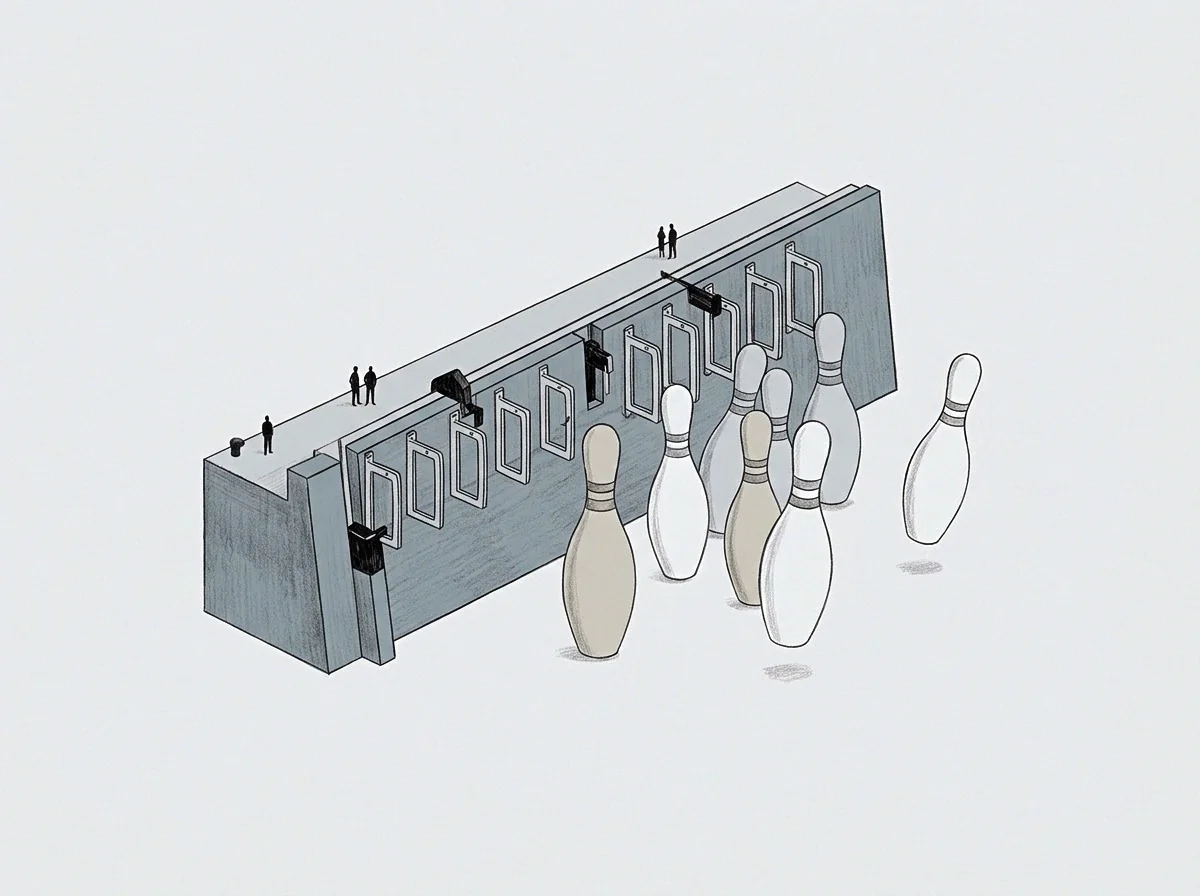
Physical Friction and Administrative Inertia
Consider an enterprise setting where an executive states that all client proposals must specify thirty-day payment terms instead of sixty, but sets up no approval gate. A sales director working to close enterprise deals ignores the instruction, offering sixty-day terms to keep deal momentum going. Three months later, the executive reviews accounts receivable and sees extended collection cycles.
The sales director responded to existing commercial incentives. The directive failed because it relied on spoken words while leaving reward structures unchanged.
Unreinforced directives fail whenever they run counter to active financial incentives. Spoken instructions cannot override a compensation plan. When an executive asks for actions that lower an operator’s immediate bonus, commission, or daily convenience, relying on a single conversation is realistic only in theory.
The incentives tied to the role dictate the actual output.
A directive left without inspection survives only when it aligns with the counterparty’s practical self-interest.

Silence
The period following an unreinforced directive generates useful structural data. The executive speaks, and days pass without follow-up. What happens during this stretch of silence exposes the implicit agreement between founder and management.
Unstated mutual expectations shape organizational commitment more strongly than written contracts, making the silence after an unmonitored directive a clear test of capacity.
Unmonitored execution spaces test whether an operator possesses independent agency or merely rents compliance by the hour.
During this silent interval, the operator considers three distinct interpretations:
- The Prioritized Test treats the lack of oversight as a deliberate diagnostic check, prompting quick execution to demonstrate operational maturity.
- The Administrative Oversight assumes the executive spoke casually and forgot the remark, using that assumption to avoid spending time on short-lived ideas.
- The Resource Scarcity Defense concludes that existing client deliverables take precedence, setting the unreinforced task aside until project management systems require action.
None of these reactions are irrational; each stems from past organizational experience. If an executive regularly introduces short-lived ideas that disappear within forty-eight hours, an experienced division head learns to let unreinforced requests sit. If the executive never brings up the topic again, the division head spared the enterprise forty hours of wasted work.
If the executive demands progress three months later, the organization faces an immediate operational strain.

Does Silence Constitute Operational Rejection?
A founder tells an operations director that product delivery cycles must drop from fourteen days to nine. The director raises no objections during the meeting. Six weeks pass without an update, no changes are made to warehouse operations, and delivery times remain at fourteen days.
The founder views this inaction as insubordination. The operations director sees it as practical prioritization, knowing the warehouse operates at ninety-six percent capacity and that cutting delivery times requires hiring four temporary packers. Because the founder never authorized additional headcount or requested a budget, the director assumed the directive was a casual idea rather than a firm operational mandate.
This situation illustrates the gap between implied preferences and concrete terms. The founder wanted nine-day shipping, but failed to establish terms covering resources, dates, and clear accountability. The operations director stayed within existing constraints.
When friction arises, the founder sees passive resistance, while the director sees unpredictable direction. The underlying issue remains whether the director ignored a requirement or the founder failed to define one.

Default
When an unreinforced directive fails, the enterprise reaches default, the point where the lack of execution becomes undeniable. The timeframe has passed, and no change occurred: client contracts remain unreviewed, software licenses stay active, or shipping schedules stay fixed. Traditional management frameworks handle default through disciplinary reviews.
Under closer operational assessment, default marks the boundary between founder bandwidth and team capability.
At default, an executive must look at communication habits across the organization. When leadership repeatedly issues verbal mandates without follow-up, teams adapt by developing a tolerance to casual direction. Staff recognize that spoken requests rarely bring consequences, turning directives into background noise.
Employees then focus strictly on metrics tied to compensation, task queues, or direct oversight.

The Cost of Retrospective Enforcement
Enforcing a directive months after issuing it, without having checked on progress along the way, causes severe operational breakdown. When an executive suddenly remembers a past instruction and penalizes an employee for non-compliance, the employee sees the move as arbitrary. The working relationship breaks down.
The employee concludes that performance is measured not by completing defined duties, but by guessing which offhand comment will later carry severe penalties.
Organizational sociology shows that breaching unstated expectations eliminates discretionary effort. Operators stop offering proactive solutions and retreat into literal execution, completing only tasks backed by written documentation or system tickets. Retrospective enforcement costs the founder the loss of employee initiative.
A mandate spoken without an inspection mechanism teaches an entire enterprise that executive words carry no structural mass.
Consider a product design team where an executive mentions in passing that the checkout flow needs fewer steps. The team notes the comment, but the backlog already holds fifty scheduled bug fixes. No tickets are reprioritized.
Two months later, the executive inspects the product, sees the original checkout flow, and criticizes the engineering lead in a public channel. The engineering lead begins looking for another job that evening. The cost of the unreinforced directive was not just a longer checkout flow, but the loss of a senior technical lead.
A subordinate in that position will inevitably conclude that if the task were truly critical, executive leadership would not have left it unmentioned for three months.

Severance
Separating executive directives from tracking systems is sometimes unavoidable. A founder managing three hundred employees across four time zones cannot monitor every delegated task. Executive capacity is finite.
Directives will be spoken, messages sent without tickets, and instructions delivered without automated tracking. The goal is setting clear diagnostic rules for issuing and evaluating unmonitored requests.
The solution is not buying management software to track every interaction, which often just digitizes bureaucracy. Instead, spoken directives can be structured into single-statement terms that establish clear, binary responsibility from the start.

The Single-Statement Protocol
To avoid covert contracts, an executive must state the directive, the completion date, and the consequence of silence in one sentence. The statement requires no tracking software or micromanagement; it transfers operational responsibility to the receiver immediately.
An effective single-statement term contains three core elements:
- The Specific Output describes the concrete result required, avoiding vague expectations or subjective metrics.
- The Absolute Horizon marks the exact date and time responsibility expires, eliminating shifting assumptions about priority.
- The Autonomous Delivery Clause confirms that no reminders or follow-ups will occur before the deadline, establishing that non-delivery represents a structural default.
Instead of saying client onboarding needs to improve, an executive states: “Review the client onboarding process, identify two stages to cut, and email the revised workflow by Friday at five; I will not ask for updates between now and then, and if nothing arrives, I will assume the initiative has failed under your management.” The directive remains unreinforced by tracking systems, yet ambiguity disappears. The operator knows the conditions, understands the criteria, and carries full responsibility for the outcome.
Applied consistently, the unreinforced directive serves as a clear filter for assessing independence. It separates autonomous operators from those who depend on continuous supervision. The executive stops managing daily tasks and evaluates autonomy directly.
Those who require constant prompting demonstrate it through inaction, while those who deliver on a single statement earn broader operational latitude.
A single stated term, delivered with an explicit deadline and no intermediate reminders, shifts the risk of default onto the operator in the seat.