
Preventing Co-Founder Equity Deadlock Through Early Vesting and Property Assignments
Early vesting schedules and property assignment agreements eliminate equity deadlocks by enabling corporate repurchase of departed shares and securing title to assets.

Split
A partner leaves in month seven, logs out of the repository, and retains half the common stock while ignoring communications. The enterprise carries liabilities, client commitments, and an unbuilt product, yet the remaining operator holds no formal mechanism to compel the return of issued shares or cancel equity control. When prospective investors review the capitalization table, the departed partner occupies a block capable of rejecting major corporate transactions, blocking subsequent funding, and claiming half the proceeds of any eventual sale.
Equal allocations made at incorporation without forfeiture terms assume uniform commitment across an indefinite horizon. This unstated expectation assumes both contributors will generate equivalent value for years, yet daily operations introduce personal attrition, uneven capacity, and shifting risk tolerance. Without legal terms governing early separation, the company enters an immediate governance freeze.
A silent partner holding outright shares commands an absolute veto over corporate survival without carrying daily operational risk.
Unvested equity problems compound when informal understandings replace statutory instruments. Contributors confuse initial sweat equity with permanent property ownership. A departure in the first operating year leaves the remaining builder working eighty hours every week to generate enterprise value that flows equally to a former partner who left in the second quarter.
The capitalization table freezes, rendering the business uninvestable to outside institutions and paralysed internally.
Disputes over early contributions regularly produce administrative paralysis. Voting thresholds defined in corporate bylaws mandate supermajority or unanimous shareholder approval for charter amendments, share issuances, executive appointments, and debt facilities. When a departed partner ceases communication, essential corporate actions fail by default.
Leaving exit terms unaddressed at inception often leads to corporate dissolution and the loss of accumulated capital.

Assignment

Proprietary Property Voids and Ownership Claims
Code, design systems, technical specifications, and trade secrets authored prior to or during formation belong by default to the individual author under copyright and patent law. The corporate entity holds no automatic title to work created on personal equipment before formal conveyance. When an enterprise charters without a comprehensive intellectual property conveyance, a departing founder retains personal ownership of the codebase, proprietary algorithms, and brand assets.
This statutory reality creates significant leverage for the departing party. The remaining builder cannot license, modify, or transfer the software without facing potential infringement claims from the former partner. Outside counsel conducting legal due diligence will halt financing proceedings upon discovering that core technical assets remain in the personal possession of a hostile ex-partner.
A comprehensive invention assignment signed at incorporation extinguishes individual proprietary claims before software architecture gains commercial value.
The core structural instrument is the proprietary information and inventions assignment agreement. This instrument assigns all prior, current, and future relevant intellectual property unconditionally to the company. Execution occurs alongside stock purchase agreements on the day of incorporation.
- Present assignment clauses convey all existing inventions directly through explicit transfer language rather than promising future conveyance.
- Quitclaim provisions extinguish any residual common-law claims, moral rights, or undocumented pre-incorporation ownership assertions against company assets.
- Power of attorney terms authorize corporate officers to execute patent, copyright, and registration documents if an author becomes unreachable or recalcitrant.
Without these provisions, an enterprise builds upon quicksand. Software developers routinely assert that pre-incorporation prototypes constitute personal property retained outside company ownership. Litigation regarding proprietary ownership rarely reaches a resolution because legal expenses exhaust cash reserves within months.
Express contract language granting the company permanent, global ownership of all related technical output forces intellectual property to remain an asset of the business regardless of personnel departures.

Repurchase
Corporate equity must not be granted as an outright, unconditional transfer at inception. The structural remedy against dead equity is the restricted stock purchase agreement linked to a four-year vesting schedule with a one-year cliff. Under this arrangement, the company retains an explicit contractual option to repurchase unvested shares at the original nominal issuance price upon the termination of service for any reason.
A departure before the completion of twelve continuous months results in the immediate cancellation or repurchase of all issued shares. The departing peer retains zero equity, leaving the capitalization table intact for replacement talent. Vesting schedules maintain parity between equity retention and actual tenure.
The corporate right to repurchase unvested shares at par value prevents departed contributors from collecting long-term enterprise rewards.

How Accelerated Repurchase Clears Voting Impasses?
When an operating split occurs, voting control often hangs on unvested equity balances. The company exercises its repurchase option by delivering written notice and wiring par value payment to the departing holder. This mechanical step extinguishes the stock certificates and cancels the voting power associated with unvested blocks.
- The board delivers formal written notice of termination to the departing contributor.
- Corporate officers calculate vested percentage against the verified calendar cliff and monthly milestones.
- The treasurer issues tender payment at original issue price for all unvested share tranches.
- The corporate secretary cancels unvested shares in the master capitalization ledger.
Equity holders frequently misunderstand the relationship between restricted stock and taxation. Filing a Section 83(b) election with the Internal Revenue Service within thirty days of stock grant confirms taxation at nominal valuation rather than as future vesting increments occur. This administrative filing protects the builder against catastrophic tax bills when value accumulates.
Equity retention must match operational duration.
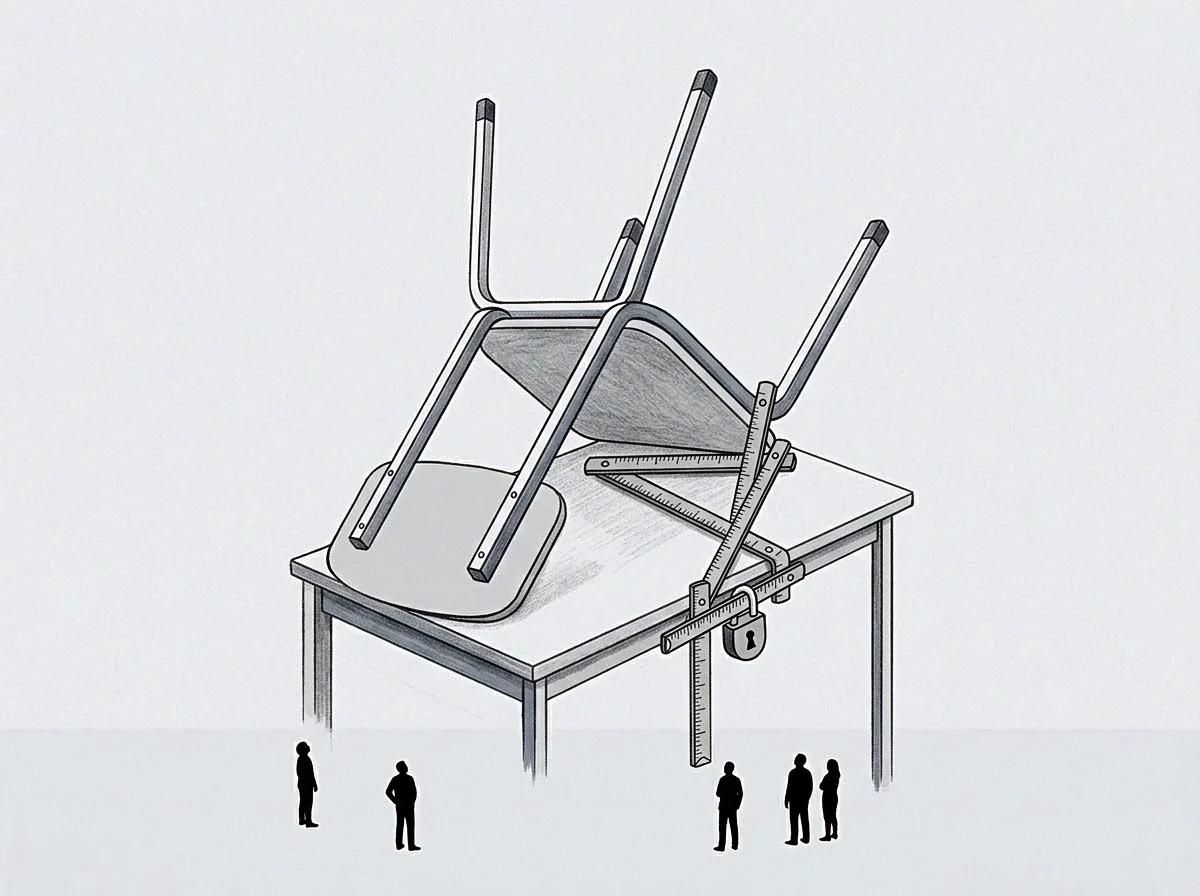
Lock

Governance Ratios and Voting Deadlock Mechanisms
Fifty-fifty ownership distributions present an existential hazard to early corporate survival. Two equal shareholders holding identical board seats can paralyse corporate governance whenever an operational dispute arises. Neither party commands a majority to approve budgets, issue commercial equity, or hire key executives.
State corporate law offers few remedies outside costly statutory dissolution proceedings.
Protective mechanisms rely on structural separation between economic rights and corporate governance authority. Founders can equalize cash flow distributions while implementing uneven board allocations, independent tie-breaking directorships, or voting agreements that delegate specific administrative spheres to designated operators.
| Structural Variable | Outright Equity Grant | Restricted Stock and IP Assignment |
|---|---|---|
| Cap Table Status | Permanent dead equity overhang | Unvested equity reclaimed at par value |
| Proprietary Rights | Individual authors retain claims | Corporation owns all source assets |
| Financing Viability | Institutional diligence fails | Clean capitalization invites investment |
| Board Deadlock | Unanimous consent requirements freeze entity | Repurchased shares eliminate blocking votes |
Drag-along covenants embedded in shareholder agreements prevent minority or departed holders from blocking acquisitions or subsequent institutional rounds. When a designated majority votes to approve a merger, recapitalization, or stock sale, the drag-along forces every signatory to vote in favor and execute matching transactional agreements.
Agreements executed early protect corporate life when personal alignment collapses.
A departing peer faced with drag-along clauses and repurchase enforcement cannot extort cash premiums in exchange for signatures. The corporate bylaws establish predictable tracks for executive transitions, preserving operating momentum.

Remedy
Restructuring an impaired company after deadlock has occurred demands rigorous transactional surgery. When a non-working peer holds outright shares without vesting, the remaining operators must choose between an expensive equity buyout, an asset transfer to a newly formed corporation, or immediate dissolution. Buyout negotiations absorb months of executive focus, draining liquidity through legal retainer fees and advisory expenses.
Asset conveyances to a new entity carry substantial legal risk if fiduciary duties to existing shareholders are breached. The remaining operator cannot strip enterprise value from the original company to freeze out an unvested holder without exposure to minority oppression lawsuits. Clean corporate architecture at incorporation eliminates this category of risk before work begins.
Establishing reverse vesting agreements, comprehensive invention assignments, and voting trusts requires several hours of legal documentation during the initial registration process. Deferring these legal structures until outside capital demands them leaves the entity unprotected throughout its most vulnerable operating period. Stated legal terms create operational certainty.
Whether contractual governance structures can fully survive aggressive litigation when early-stage equity values abruptly cross hundreds of millions of dollars remains an ongoing question in corporate chancery courts.