
Stating Clear Ownership Conditions Before Shared Development Begins
Stating explicit intellectual property assignment terms before shared development transfers output ownership to the entity and prevents unassigned copyright claims.

Filter
Two people pull up chairs before a repository or sketch and write the initial lines of a system without assigning intellectual property. When code or architecture accumulates without explicit assignment, default copyright rules award authorship directly to whoever typed the syntax. An informal collaborator owns what they wrote until a signed document transfers title.
Leaving conditions unstated does not preserve flexibility; it creates an arrangement where each party assumes future control without paying for it upfront.
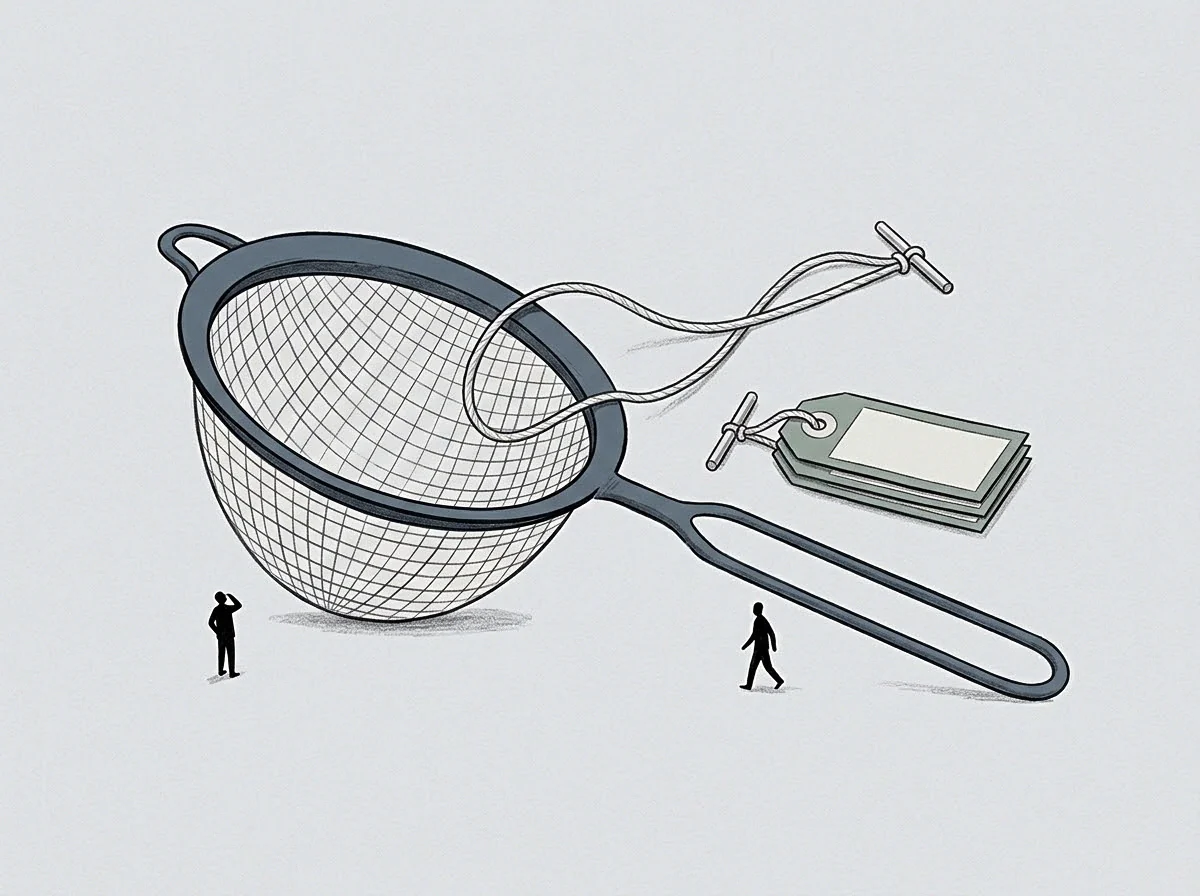
A term stated early acts as a filter. Specifying that all commits, system schemas, and documentation produced during exploratory work belong exclusively to the operating entity removes ambiguity before shared labor builds value. The counterparty either signs the assignment or steps away.
The friction of that single declaration costs an uncomfortable conversation, but postponing it until a funding round or acquisition forces founders to buy back rights given away in mutual silence.
A contribution agreement executed before the first repository commit prevents subsequent claims of joint authorship.
In practice, parties resist early definitions because assigning ownership introduces tension into collaborative goodwill. Presenting an assignment document feels socially costlier than working in good faith. That calculation ignores how code and architecture compound: every unassigned module increases a contributor’s future leverage against the project.
Setting the condition early shows whether a collaborator values the shared venture or their own latent position.

Exploratory Labor and Default Copyright Allocation
Independent contractors and informal collaborators retain ownership of intellectual property by statutory default without a written assignment. Paying for dinner, granting server access, or providing product direction does not transfer copyright under the law. Under United States copyright statutes, without a written instrument designating work made for hire or assigning rights, independent developers retain legal title to their contributions.
This principle applies across most common law jurisdictions.
A technical collaborator can step away after six weeks of work and legally reuse that exact architecture elsewhere, or block the project from deploying it without a license. The resulting deadlock stops capitalization. Diligence attorneys compare repository logs against signed assignment dates; any gap between the first commit and the signed document creates an ownership cloud.
Resolving it later requires tracing lines of code back to specific individuals and negotiating retrospective assignments under commercial pressure.
Stating terms prior to joint technical labor establishes that all output belongs to the entity, leaving no unassigned commits in the repository history.
Desk
Work happens on physical hardware, local branches, and shared services before incorporated structures exist. When two developers sit at a shared table building an initial product, digital custody creates confusion. One contributor hosts the database on a personal account while another stores repositories under an individual handle.
Operational access ends up substituting for documented title.
Administrative access does not confer commercial ownership. Holding admin rights to cloud services or managing the main repository branch fails to secure the enterprise against future ownership disputes. A contributor who leaves with administrative credentials can hold the product hostage regardless of who designed the operational model.
Segregating personal hardware from project environments protects against claims of commingled assets.
Equipment ownership and administrative custody remain subordinate to written contractual assignment.
Consider how initial technical assets are allocated across exploratory builds. The rules governing assignment, vesting, and asset segregation determine who retains control once joint development begins.
| Control Dimension | Informal Shared Work | Documented Proprietary Transfer |
|---|---|---|
| Source Code Copyright | Retained by individual authors | Assigned exclusively to entity |
| Service Infrastructure | Fragmented across personal credentials | Consolidated under corporate ownership |
| Contributed Architecture | Vulnerable to competing commercialization | Restricted by intellectual property transfer |
| Founder Departure Leverage | High potential for project injunction | Limited to vested equity percentage |
Repositories record commits and hosting accounts log deployments. Without clear assignments signed before the first push, physical access to infrastructure becomes a tool for leverage during co-founder disputes.

Segregation of Prior Inventions
Disputes frequently arise when prior libraries are imported into the joint environment. A collaborator brings existing scripts, database schemas, or utility tools into the shared codebase to accelerate early work. Without an explicit disclosure carve-out, the project incorporates unassigned personal code, attaching prior ownership claims to the repository.
A thorough assignment clause includes a detailed schedule of excluded prior inventions. The collaborator lists every preexisting script, library, or patent claim to be excluded from the transfer. Anything omitted from that schedule that appears in the repository falls under the assignment or receives a perpetual, royalty-free, irrevocable commercial license.
Written carve-outs clarify where past labor ends and entity property begins.
Failing to demand this inventory at the outset leaves the venture exposed to claims that core infrastructure rests on a contributor’s unassigned personal library, forcing expensive rewrites later during growth.

Breach
Unstated expectations create operational friction over time. When collaborators avoid defining intellectual property allocation, each party works under different assumptions. One expects fifty percent equity for advisory work and high-level architecture, while the other expects equity to accrue only for full-time operational work.
Because neither stated their terms aloud, both proceed under conflicting assumptions.
Research across technical partnerships identifies unstated expectations as the primary trigger for conflict. Conflict occurs when commercial reality forces an explicit account, such as drafting a capitalization table. The collaborator who offered occasional architecture guidance feels slighted when offered a small advisory grant, while the full-time builder feels exploited when asked to give up half the enterprise for ten days of informal whiteboard sessions.
The relationship fractures because each assumed their own expectations were self-evident.
Unstated terms produce debt.
Stating conditions before development turns informal goodwill into explicit terms. An individual who planned to contribute casual advice for substantial equity will object to an assignment requiring full property surrender without immediate equity guarantees. That objection offers clear signal: it reveals a fundamental divergence in valuation before significant time and resources are committed to the architecture.
The Cost of Delayed Confrontation
Delaying ownership discussions until after a product launch multiplies commercial friction. As traction emerges, the perceived value of early contributions escalates. An informal contributor who wrote thirty hours of exploratory code six months earlier may view that work as foundational to the entire valuation.
Resolving these disputes becomes harder with every unassigned commit. Early on, walking away costs zero capital and a few days of work. Six months later, departing without signed intellectual property assignments jeopardizes customer contracts, seed financing, and platform stability.
Stating terms on day one forces collaborators to address misalignment while leverage remains low.
Collaborators build the platform together from nothing, yet launch remains blocked without compensating the foundational contribution.

Position
Establishing clear ownership conditions requires formal commitments before initializing a development environment. The process starts with an intellectual property assignment combined with a confidential information and inventions agreement. This requires that all inventions, designs, and code conceived during the collaboration belong to the enterprise, regardless of whether work occurred on personal devices or outside standard hours.
When an individual refuses to sign an intellectual property assignment before writing code, that refusal clarifies the arrangement immediately and ends the technical engagement before proprietary work reaches their machine. Equity does not transfer without a written agreement, and codebase access requires full legal assignment.
A secondary term governs vesting schedules for equity issued for development labor. Equity granted without a four-year vesting schedule and a one-year cliff risks early departures with unearned equity. A co-founder who leaves after four months holding twenty percent of common stock creates a heavy burden on the capital structure.
Vesting conditions ensure ownership tracks sustained execution rather than initial enthusiasm.
Documented conditions protect the enterprise against statutory defaults that favor individual contributors over the collective entity. Communicating these stipulations cleanly sets the operational standard for subsequent commercial engagements.

Contractual Instruments of Clean Ownership
Securing clear title requires specific legal vehicles deployed before product conception. Generic non-disclosure agreements do not assign copyright or patent rights. The foundational documentation relies on three structural commitments:
- Proprietary Information and Inventions Agreement vests output created by the contributor into the corporate entity through present assignment language rather than promises of future transfer.
- Preexisting Inventions Schedule documents prior intellectual property owned by the collaborator, isolating past creations from the new entity codebase.
- Restricted Stock Purchase Agreement subjects equity to reverse vesting schedules, giving the company repurchase options if a collaborator departs early.
Clarity established at inception shields the venture from severe dilution, capitalization failure, and co-founder deadlock. Operating without documented terms transfers control from active builders to a departed contributor.
The founder who sets terms early maintains control of the enterprise, while one who relies on informal sentiment often ends up buying back their own product.