
Structural Limits Of Formal Hierarchy When Operational Grounding Diverges Permanently Across Institutional Tiers
Hierarchical authority collapses when administrative tiers issue commands based on abstract metrics that permanently contradict frontline physical constraints.

Room
An executive council on the fourteenth floor approves an operational protocol for physical distribution facilities three states away. The directive specifies twenty-minute turnarounds for pallet intake, logged through an enterprise terminal designed six months prior by analysts who have never touched a forklift. Down in the terminal transfer bay, hydraulic lifts run five minutes slower during morning frost, barcodes printed on frozen shrinkwrap reflect glare into handheld optical scanners, and seasoned dispatchers routinely bypass formal intake prompts by manually entering stock numbers saved in personal notebooks.
The administrative tier operates on clean geometric models of production. The physical worksite operates on friction, temperature variations, and the informal accommodations workers maintain to keep freight moving.
Structural hierarchy depends on an implicit assumption of shared operational reference. When administrative authority sits two or three organizational tiers removed from physical execution, daily reality ceases to travel upward in its raw form. The higher tier encounters an idealized abstraction of workflow, assembled from tidy aggregations, progress dashboards, and filtered milestone summaries.
The lower tier encounters unyielding physical constraints, machine degradation, client idiosyncrasies, and the sheer inertia of real materials. When this divergence becomes permanent, administrative orders cease to function as coordination instruments. Directives arrive at the ground level as arbitrary obstacles, compelling operational staff to choose between adhering to hierarchical commands or sustaining actual throughput.
A command hierarchy detached from operational physics produces compliance rituals that actively conceal equipment failure.
Administrative tiers frequently interpret non-compliance as cultural resistance or insufficient oversight. The conventional administrative remedy introduces surveillance tools, increased reporting intervals, and tighter middle-management audits. These measures worsen systemic detachment.
Operational crews respond to heightened surveillance by perfecting the presentation of compliance while shifting necessary workarounds into deeper invisibility. The formal reporting layer becomes a theater of synthetic harmony. The operational foundation drifts further away, governed by undocumented pacts and unspoken compromises that leadership never sees.
Pact
The Architecture of Covert Working Agreements
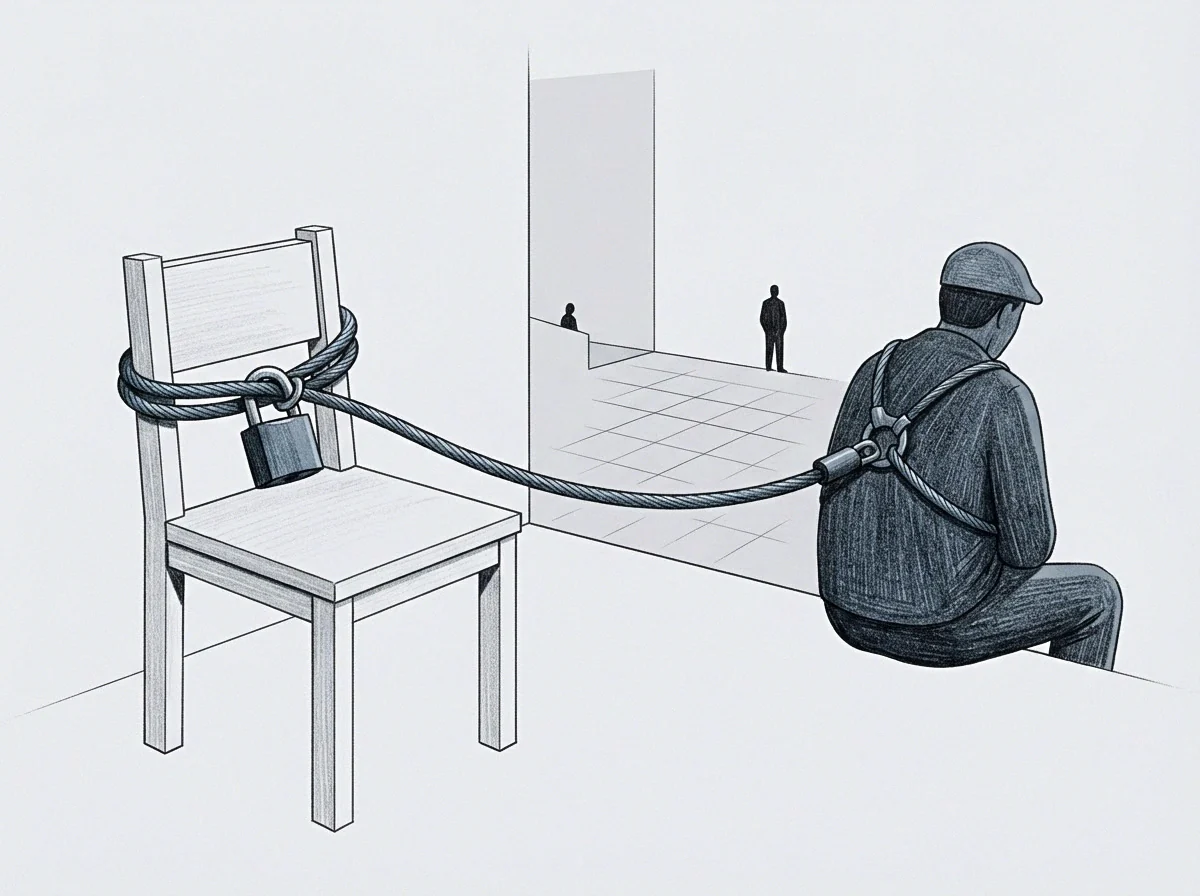
Operational personnel confronting unworkable mandates inevitably form a covert contract across their immediate tier. This unwritten pact establishes which formal instructions receive genuine execution and which instructions receive mere clerical confirmation. A supervisor nods during the Monday executive teleconference, pledges full adherence to new centralized data-entry rules, and returns to the bay to tell shift leaders to record estimates at the end of the shift so daily transport schedules do not collapse.
The supervisor protects the crew from administrative harassment. In return, the crew protects the supervisor from catastrophic shipping delays.
Sociological studies of administrative systems demonstrate that informal networks preserve operational viability precisely by violating impossible formal commands. When executive management mandates contradictory targets, such as reducing labor hours while demanding instantaneous throughput gains, lower tiers cannot comply through literal obedience. Operational actors resolve the structural contradiction locally.
They absorb variance, cover machine downtime with creative workarounds, and construct defensive operational buffers that isolate their day-to-day work from executive scrutiny.
The unstated expectation creates severe institutional exposure. The informal accommodations that preserve daily execution remain entirely unbilled until an acute mechanical breakdown occurs. Executive tiers, shielded from physical ground truths by months of falsified compliance figures, react with surprise when delivery targets drop overnight.
They identify frontline failure where there was only the terminal exhaustion of unacknowledged operational subsidies. The ground crew spent years absorbing structural deficits without formal recognition, generating a deep deficit of trust that ruptures the moment administrative leadership demands accountability for metrics rooted in administrative imagination.
Give us instructions that survive contact with the machinery, or run the warehouse from your own clean desks.
Signal

Asymmetric Filtering and Information Decay
Ascending institutional communication suffers severe attenuation at every hierarchical junction. Middle managers occupy an unenviable junction between executive expectations and physical limitations. Presenting raw operational constraints to upper leadership invites accusations of poor managerial command or negativity.
Consequently, middle managers apply an interpretive gloss to field telemetry. Unfavorable variances transform into temporary anomalies, supply shortages become minor sequencing adjustments, and structural equipment wear appears as planned maintenance deferrals.
- Structural opacity develops when multi-tiered organizations treat smooth reporting artifacts as evidence of operational stability, leaving field crews isolated against deteriorating tooling.
- Metric divergence deepens as upper tiers incentivize symbolic key performance indicators, rewarding operational units for reporting flawless numbers rather than diagnosing physical bottlenecks.
- Operational insulation establishes an unbridgeable social distance between decision-makers and line personnel, replacing mutual observation with speculative presentations and slide decks.
Stated requirements survive institutional distance only when empirical validation mechanisms penalize upward deception.
The resulting operational fiction breeds false confidence at upper institutional tiers. Executives design major financial projections, capital allocations, and customer commitments against synthetic data. When ground realities assert themselves through cancelled orders, safety violations, or sudden labor turnover, upper tiers double down on algorithmic management.
They introduce prescriptive digital platforms that eliminate supervisory discretion, attempting to enforce obedience through code.

Will Executive Mandates Bridge Divergent Operational Realities?
Hierarchical commands possess jurisdictional authority, yet lack mechanical traction over divergent physical realities. Code-enforced management platforms fail because they cannot perceive physical exceptions. When an algorithm schedules maintenance based on theoretical running hours rather than ambient heat and dust exposure, bearings seize mid-production.
Line mechanics identify the impending failure hours before the diagnostic platform registers an alarm, but formal hierarchical communication channels discard physical intuition in favor of computational output.
A systematic operational decoupling follows. Executive officers formulate long-range initiatives that assume frictionless organizational compliance. The operational tier ignores the strategic vision entirely, focusing exclusively on localized triage and the preservation of basic workflow.
When systemic collapse occurs, the institutional cost lands as sudden balance-sheet impairments, catastrophic customer churn, and a wholesale loss of operational competence that capital injections alone cannot repair.
Dispute
Structural friction between institutional tiers manifests as an intractable dispute over legitimacy, authority, and baseline reality. Upper tiers invoke fiduciary duty, enterprise scope, and formal mandate. Lower tiers invoke physical experience, immediate danger, and the raw physics of daily production.
Neither tier recognizes the evidentiary standards of the other. The table below delineates the structural cleavage between formal administrative assumptions and operational ground conditions across primary organizational dimensions.
| Dimension | Administrative Tier Assumption | Operational Field Reality | Systemic Consequence |
|---|---|---|---|
| Work Definition | Tasks follow explicit documented procedures. | Work relies on adaptive tacit improvisation. | Protocols fail during unanticipated physical disruptions. |
| Information Flow | Reports reflect objective operational conditions. | Data undergoes defensive political sanitization. | Strategic decisions rely on operational fiction. |
| Authority Basis | Jurisdictional mandate and title establish command. | Demonstrated mechanical competence commands trust. | Directives face passive procedural sabotage. |
| Variance Handling | Deviations indicate defective worker discipline. | Deviations represent vital survival adaptations. | Punitive audits extinguish frontline problem-solving. |
| Temporal Horizon | Planning occurs across quarterly financial cycles. | Execution resolves immediate physical emergencies. | Strategic initiatives collapse under short-term friction. |
Attempting to arbitrate this divergence through executive decree generates procedural stagnation. When leadership resolves disputes by asserting formal rank, frontline staff retreat into malicious compliance. Workers execute exact written orders with full knowledge that the instructions will damage tooling or halt output.
The resulting damage delivers definitive empirical proof that upper management does not understand field operations, yet leadership routinely interprets the outcome as employee insubordination.
A stated limit provides structural clarity where hierarchy falters. When an operational director steps into the boardroom and names the exact physical throughput capacity of the machinery, refusing to validate fictional revenue models, the dynamic alters. The statement cuts through months of polite managerial obfuscation.
Stating a hard physical limitation once, flatly and without apology, establishes an immovable reference point that forces administrative planning to reckon with material reality.
A physical constraint stated once with unyielding precision halts bureaucratic fantasy faster than an ocean of disputed telemetry.
Authority extends only as far as direct mechanical verifiability reaches.

Border
Every administrative structure reaches a firm territorial perimeter where jurisdictional sovereignty yields to physical law. Beyond this boundary, formal status counts for nothing. An executive vice president can command an industrial centrifuge to run without scheduled cooling cycles, but metal expansion under heat ignores administrative rank.
The point where administrative mandate encounters physical intransigence is the true institutional frontier. Surviving this collision requires organizations to trade hierarchical supremacy for empirical grounding.
Re-establishing operational grounding demands structural renegotiation across tiers. Administrative tiers must surrender the comfort of tidy, predictable dashboards and accept messy, unstandardized operational feedback. This transition carries significant friction.
It exposes executive leadership to the uncomfortable truth that prior financial milestones succeeded because frontline staff routinely violated corporate policies to overcome structural design flaws. Acknowledging that reality dismantles the narrative of effortless managerial control.
The strategic move centers on establishing explicit, unambiguous terms before capital commitments lock an enterprise into unviable operational pathways. An executive team contemplating an organizational restructuring must bring operational line leaders into the design room as equal architects rather than passive recipients of top-down edicts. If the operational layer states that a proposed logistical schedule cannot function without a forty percent increase in physical staging capacity, that statement stands as an unyielding architectural term, not a negotiating posture.
Organizations that sustain long-term resilience establish low-friction channels for operational vetoes. When field operators possess formal authority to halt administrative initiatives that violate baseline physical realities, the destructive cycle of defensive deception ceases. Trust returns as an operational fact rather than a corporate aspiration.
The enterprise aligns its strategic ambitions with its genuine mechanical capacities, shedding the expensive theater of synthetic compliance.
How long can an executive tier preserve formal institutional authority once operational crews realize that daily survival depends entirely on their willingness to ignore executive commands?