
Managing Early Equity Splits When Operational Demands Change
Early equity splits hold only while operational burdens match initial assumptions, requiring structural reallocation once contributions permanently diverge.

Pact

Initial Symmetry in Early Undertakings
Two collaborators sign an incorporation document at a kitchen table, splitting shares equally while the business exists only on paper. The gesture reflects mutual trust and high expectations. Both expect matching stamina, identical risk tolerance, and similar weekly schedules, and the legal filings record that initial enthusiasm as permanent ownership.
Early on, work moves much like assistance between friends. One co-founder codes for sixteen hours straight while the other drafts contracts and sets up meetings. Neither logs time or bills for weekend labor.
Research on generalized reciprocity shows that close groups exchange help without keeping counts, expecting contributions to even out eventually. That trust holds up well enough while capital needs remain small and immediate tasks take priority, letting the venture absorb whatever hours each person can give.
A fixed equity allocation preserves peace only while operational contributions match the initial forecast.
Unplanned friction usually hits within months. The software architecture requires twenty revisions before a client pays, or regulatory filings delay the release. Initial intentions run into the practical demands of daily execution, which requires steady presence, repetitive technical fixes, and constant client management.

The Weight of Changed Commitments
Friction starts quietly when schedules diverge. One partner keeps a job to cover living expenses, giving ten evening hours a week. The other quits their job and spends sixty hours a week at the workspace without a salary.
The full-time partner handles outages, customer complaints, and cash shortfalls as they happen, while the part-time partner offers feedback during late phone calls.
That gap turns early goodwill into quiet tension. Social exchange studies show how informal trade breaks down when one person feels the effort has become deeply uneven. The founder managing daily work starts tracking every missed meeting, unwritten spec, and personal sacrifice.
Meanwhile, the partner with the outside job feels sidelined, maintaining that the original idea and seed money justify keeping their equity stake.
Problems compound when ownership tables reward early ideas instead of ongoing work. Investors routinely decline to fund ventures where inactive founders hold large equity blocks, leaving the cap table disconnected from actual operational needs. Avoided conversations make the gap worse, even if the initial split was intended to handle whatever changes lay ahead.
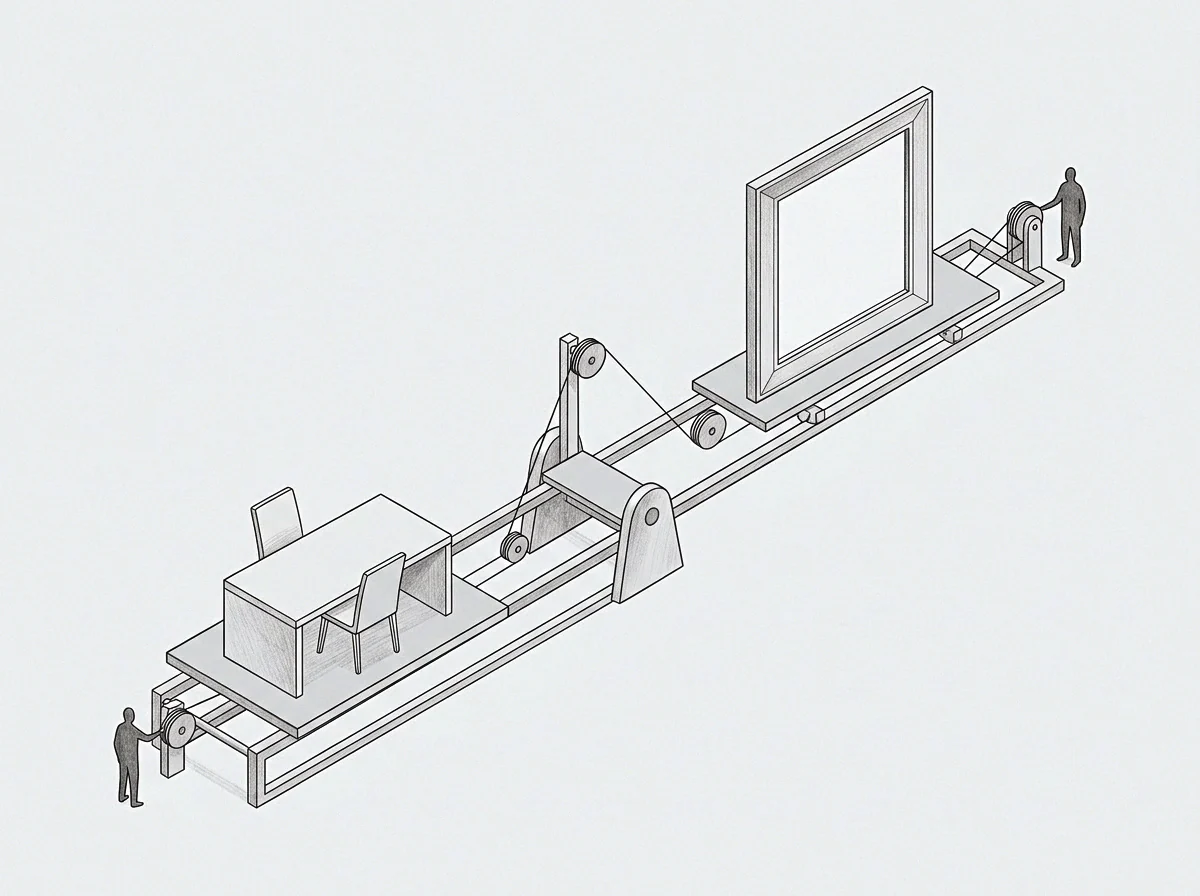
Shift

Generalized Provision Against Cardinal Execution
Informal help works at the start, but growing companies eventually require explicit accounting. When one founder logs hundreds of hours while the other checks in occasionally, the working relationship deteriorates. Anthropologist Marshall Sahlins noted that informal exchange lasts only while group solidarity remains high.
When financial pressure sets in, expectations shift toward balanced exchange, where every contribution demands a clear return.
Equal equity splits without milestones often lead to operational deadlock. Equity theory in organizational behavior shows that people evaluate fairness by comparing their efforts and outcomes against those of their peers. If an active founder sees a partner getting the same financial upside for a small fraction of the effort, motivation drops, leading to reduced output or growing resentment toward the ownership structure.
The partner carrying daily execution invariably bills for the silence of the other.
As operational demands increase, ownership needs to reflect current work rather than past relationships. Research on founder disputes shows that mismatched labor expectations ruin more ventures than technical failures do. This observation draws from qualitative survey data in private technology companies and would change if broader studies show capital availability matters more than operational alignment.
As things stand, active operators view heavy contribution gaps as an unsustainable drain on resources.

Whose Capacity Absorbs The Unplanned Role?
When unexpected work lands, execution falls on whoever refuses to let the company fail. An early venture acts like a leaking boat: the person bailing out water cannot stop to negotiate pay rates. The partner with an outside job protects their personal cash flow, while the full-time operator spends down their own savings.
Several legal tools can manage equity when actual contributions diverge from early assumptions. The table below outlines common mechanisms used to rebalance ownership.
| Mechanism | Operational Trigger | Relational Strain | Implementation Friction |
|---|---|---|---|
| Static Split With Voluntary Surrender | One partner voluntarily steps down or reduces equity percentage via formal transfer. | Extremely high, dependent on selfless capitulation and personal sacrifice. | Low legal complexity, high emotional resistance. |
| Reverse Vesting Schedule | Failure to deliver full-time operational exertion over a multi-year vesting calendar. | Moderate, because conditions were legally established in corporate bylaws. | Standard legal implementation through stock restriction agreements. |
| Adjustable Milestone Allocation | Achievement of specific quarterly revenue, technical releases, or labor commitments. | Low to moderate, evaluated against verifiable production targets. | High accounting and legal maintenance, requiring rigorous governance. |
| Compensatory Dilution Pool | Issuance of new equity classes or options exclusively to active operational personnel. | Moderate, dilutes non-active owners without direct stock forfeiture. | Requires board authorization and sufficient unissued corporate share volume. |
Hysteresis provides a helpful analogy for equity drift: once stress deforms a physical system, it does not simply snap back along its original path when relief comes. Similarly, once a founder realizes they are running the business alone, retroactive equity talks rarely restore their original working trust. Unaddressed differences in daily effort lead to management paralysis, where every decision gets weighed against background ownership frustration.

Clock

The Toll of Phantom Full Time Seats
In early ventures, time tests viability faster than cash reserves do. A co-founder holding a full-time role on paper while contributing sporadically creates an empty seat that cannot easily be filled. Key talent cannot be hired because the title and equity pool are already committed, leaving the active founder to handle sales, vendor calls, and technical maintenance all at once.
Consider two founders who built a business for twelve months under an equal split, each holding four hundred thousand shares. The company hits complex regulatory hurdles requiring eighteen months of filings. The first founder takes an executive role at an established company, offering to manage filings between eight in the evening and midnight.
The second founder stays on site, working sixty hours every week to negotiate with inspectors and update core documentation. Six months in, the second founder has put in fifteen hundred hours of direct work, compared to two hundred hours of sporadic review from the first.
The active partner ends up giving fifty percent of the company to someone insulated from its daily survival. With equity reserves tied up, the business cannot hire a qualified regulatory lead. In physical manufacturing, an absent worker stalls the line immediately; in corporate structures, an inactive partner keeps accumulating equity value while the business runs on someone else’s labor.

Unstated Hours and Latent Obligation
Unspoken expectations eventually create hidden resentment. When an active operator works through holidays while a partner is absent, an implicit debt accumulates. Sociological research on gift exchange notes that gifts given with unstated expectations strain social bonds.
The giver expects deference, while the recipient feels an unclear obligation. In business partnerships, the active founder often starts making decisions unilaterally, restricting operational visibility as informal offset for extra work.
When asked to give up shares voluntarily, the part-time founder declines, pointing to early ideation, original intellectual property, and personal lease guarantees. Those claims carry legal weight under standard corporate filings. But market reality places little value on past ideas when current execution falters, and early enthusiasm cannot settle vendor invoices.
It remains open to debate whether early conception warrants a higher equity share than daily execution during high-stress periods. Industry standards vary: software markets heavily discount static ideas, while pharmaceutical sectors often grant substantial passive equity for early patent rights. In general business, an inactive co-founder who demands equal control without putting in the work usually forces the venture apart.
Equity remains balanced only so long as ongoing labor supports the company’s operations.

Remedy

Contractual Vesting Acceleration and Repurchase Options
Handling differences in founder contribution requires clear legal mechanics rather than personal arguments. As commitments change, corporate documentation should reflect current work. Setting up a business without reverse vesting agreements leaves it open to deadlocks if someone steps back.
Reverse vesting allows the company to buy back unearned shares at nominal cost if a co-founder leaves active service.
Reverse vesting provisions return unearned shares to the corporate treasury whenever an executive steps away early.
Formal agreements take the emotion out of ownership adjustments. Common structures for rebalancing equity when contributions diverge include:
- Reverse vesting conversion places existing founder shares under a new four-year vesting schedule, with ownership earned monthly through full-time service.
- Executive share repurchase allows the business to reclaim unvested equity at par value if a founder transitions from full-time work to an advisory role.
- Contingent milestone tranches release equity portions only when specified product releases or major commercial contracts are completed.
- Differential dilution pools issue option grants exclusively to active full-time staff, reducing the percentage ownership of inactive shareholders over time.
- Synthetic phantom equity substitutes phantom stock for common voting shares for departing co-founders, preserving payout rights on exit without leaving operational control in deadlock.

Structured Dilution Through Expansion Pools
Asking a co-founder to give up stock directly often leads to strong resistance, as people view it as an admission of failure or a slight against early work. Expanding an option pool rebalances ownership through dilution rather than clawbacks.
The board creates a new equity incentive pool reserved for active team members. The working founder receives fresh restricted stock grants linked to clear operational targets. While the inactive partner keeps their original share count, their percentage ownership decreases as new shares are issued.
This structure rebalances the cap table by diluting stakes that no longer support daily operations. A repurchase right also allows the company to reclaim unvested equity at book value if work drops below agreed quarterly thresholds.

Reckoning

Stating Limits Before Bitterness Collects
Addressing uneven equity requires direct conversation. When work demands exceed what one partner can deliver, staying silent makes the situation worse. The active founder needs to raise the issue before frustration ruins the working relationship.
Waiting until an investment round approaches only raises the stakes and complicates legal cleanup.
These discussions work best when focused on business requirements rather than personal judgments. The active founder outlines what the business needs: full-time technical direction, forty hours of weekly client work, or immediate revenue. If the other partner cannot meet those demands due to outside commitments or personal limits, the equity split needs to adjust accordingly.
Treating the change as a practical operational update keeps the focus on commercial facts.
Equity reallocations function smoothly when framed around company survival rather than personal deficiency.
In many early companies, founders avoid difficult equity conversations for months, hoping workload differences will resolve on their own. That rarely happens. When operational demands diverge, clear terms offer the best way forward.

The Residual Equity of Departed Contributors
A co-founder stepping down from daily work should not leave empty-handed. Their early risk, initial capital, and early effort hold genuine value, and rebalancing equity is about fairness rather than punishment. A clean transition leaves the departing partner with a modest, fully vested equity stake that reflects their role in starting the company.
The remaining founder moves forward with majority ownership and clear authority to make decisions, free from passive friction. With the ownership structure aligned, the company can hire senior leadership, set up performance incentives, and pass investor due diligence. Whether founders can restructure an unequal split without destroying the original trust remains a difficult test for any partnership.