
Managing Institutional Resentment When Founding Team Realignment Exposes Long Standing Unstated Covert Contracts
Realignment exposes unstated covert contracts when early sacrifices are reframed from generalized gifts into explicit claims for permanent authority.

Claim
An executive search firm receives a signed retainer for a chief revenue officer role while the founding vice president of sales sits three desks away. The decision follows six quarters of plateaued enterprise deals, yet the timing creates instant institutional tremor. Three years earlier, that same vice president worked without compensation for seven months, paid for early trade show booths out of personal savings, and managed customer support tickets at midnight.
No written agreement guaranteed permanent executive tenure. The unstated arrangement relied on an implicit trade: present sacrifice for future authority.
Early operational phases run on generalized reciprocity, where initial collaborators contribute effort without immediate tallying or explicit settlement terms. Founders offer unprompted long hours, operators absorb personal financial strain, and early hires accept below-market compensation under the shared belief that future equity or status will equalize the account. This informal exchange functions effectively while uncertainty remains high and capital remains scarce.
Problems emerge when commercial growth demands operational specialization. The organization brings in professional managers, restructures internal reporting lines, and introduces formal governance metrics to match external capital requirements.
This structural shift forces an immediate audit of historical commitments. Realignment exposes the gap between what leadership views as historical generosity and what the early operator views as an earned contract. The score was never blank.
The early collaborator kept an internal tally of every uncompensated hour, treating each unprompted contribution as an advance payment on permanent authority. When leadership replaces that authority with a structured management layer, the early collaborator experiences the realignment as a direct breach of contract.
Unstated sacrifice converts into a structural liability the moment an institutional milestone replaces relational trust.
Resentment spreads across the organization through established relational channels. Early employees read the role alteration not as a neutral talent upgrade, but as an act of institutional betrayal. Teammates who witnessed the initial sacrifice align emotionally with the displaced founder, creating hidden factions within operational departments.
Misinterpreting this structural collision as a simple interpersonal grievance guarantees prolonged organizational friction and costly executive exits.

Invoice
Unprompted early sacrifice builds a psychological balance sheet that leadership rarely sees until the professionalization phase arrives. In anthropological terms, initial startup operations operate inside a gift economy where unquantified giving establishes social standing and mutual obligation. A founding engineer stays up for forty-eight consecutive hours to patch a database failure, rejecting overtime pay or immediate bonuses.
The act is presented as a gift to the enterprise. The organization accepts the gift, integrating the sacrifice into its operational baseline without defining its long-term financial or structural value.
The nature of the exchange changes as the company matures. The informal gift economy shifts into balanced reciprocity, where transactions require explicit pricing, timelines, and measurable returns. When leadership initiates team realignment, the early engineer presents the unstated bill.
That bill rarely demands cash; it demands permanent immunity from performance management, exclusive control over technology choices, or guaranteed executive titles regardless of operational scale.
- Implicit Equity Guarantee operates when an early worker accepts low pay under the unstated belief that permanent seniority will follow automatically.
- Unquantified Executive Immunity arises when long hours in early phases are treated as a perpetual exemption from modern performance metrics.
- Deferred Compensation Expectation occurs when unprompted personal sacrifices build an implicit balance sheet presented during organizational realignment.
The difficulty lies in the asymmetry of perception. Leadership viewed early sacrifices as voluntary contributions covered by initial equity allocations. The early team member viewed those same sacrifices as an unwritten, high-interest loan extended to the founding entity.
The unstated contract remains invisible while the company fights for initial survival. The moment formal alignment occurs, the covert bill gets presented for immediate settlement.

Mechanics of Generalized Reciprocity At Scale
Generalized exchange works only within small groups bound by total transparency and shared existential risk. As workforce headcount expands past thirty employees, personal trust networks fail to maintain operational alignment. Formal processes replace informal agreements.
Compensation structures standardize, role descriptions narrow, and reporting lines formalize. Early team members interpret this institutional formalization as an attack on their historical contribution.

The Shift to Disguised Balanced Barter
When an implicit gift carries a hidden price tag, any future organizational change triggers conflict. The operator who gave unprompted effort without defining terms feels cheated when those terms are defined by someone else. The business suffers because past sacrifices are converted into present veto power over operational strategy.
A gift given with an unstated expectation operates as a delayed bill with compound interest.
The early team member spent four years building the foundation, taking low pay and sleeping on office couches, only to watch an external executive receive the title, the authority, and double the equity base.
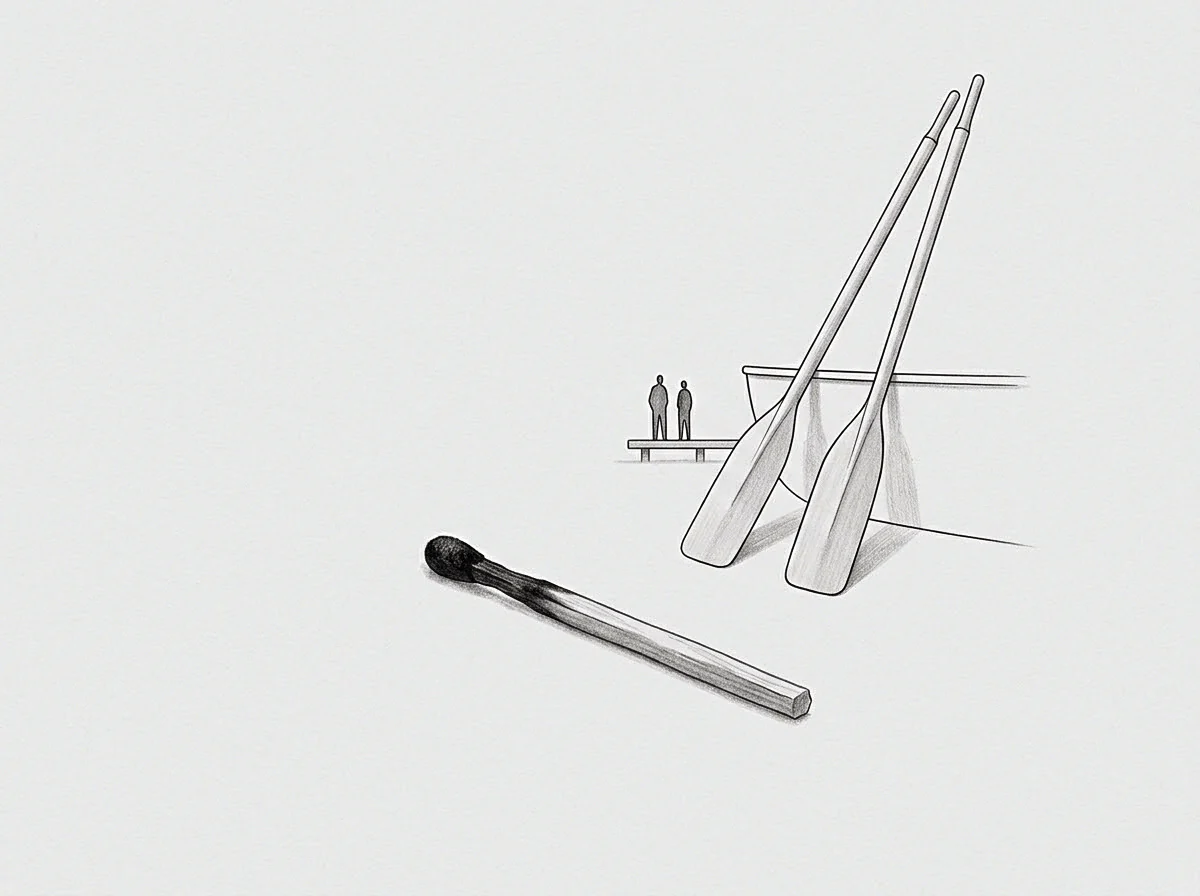
Channel
Managing the fallout from realignment requires separating personal relationships from structural operational channels. High-growth enterprises frequently collapse these distinct forms of interaction into a single ambiguous medium. The person-channel carries historical loyalty, shared emotional memory, and personal friendship.
The project-channel handles functional accountability, capital allocation, compensation terms, and reporting hierarchies. Covert contracts thrive when these two channels mix without governance.
Realignment forces an immediate, explicit division between relational goodwill and functional capability. An early collaborator may remain a trusted personal confidant to the chief executive while lacking the operational capability to manage a two-hundred-person engineering department. If leadership uses the project-channel to solve person-channel emotional obligations, the enterprise suffers operational bloat and managerial paralysis.
Conversely, evaluating historical personal loyalty purely through a transactional project lens triggers intense institutional bitterness.
| Dimension | Implicit Relational Contract | Explicit Governance Terms |
|---|---|---|
| Exchange Mode | Generalized reciprocity with unquantified expectations | Balanced financial transactions with explicit terms |
| Role Authority | Derived from historical tenure and personal sacrifice | Derived from documented competence and functional scope |
| Dispute Resolution | Emotional appeals regarding past loyalty and effort | Contractual remedies, buyouts, or formal role shifts |
| Valuation Metric | Subjective memory of personal costs incurred | Objective market benchmark for role performance |

Separating Personal Contribution From Role Design
Converting unstated commitments into explicit structural arrangements requires clear pricing mechanisms. Early equity grants were designed to offset initial salary discounts, but founders rarely explained this trade-off explicitly. When functional growth outpaces an early employee’s current skills, leadership must state the market fee for the current role rather than quietly stripping authority.

Structural Valuation of Early Effort
Unquantified barter damages organizational health because it prevents accurate financial and operational accounting. A company cannot evaluate its true cost structure if early key employees operate under informal exemptions, custom equity arrangements, or unwritten reporting exemptions. Settling these covert obligations demands transparent, written agreements that convert historical contributions into explicit financial assets or recognized advisory positions.
Relational goodwill cannot substitute for explicit compensation terms once external capital enters the organization.
The transition completes only when the early operator receives a written agreement that explicitly separates historical advisory equity from future operational compensation.

Contagion
Institutional resentment rarely remains confined to the specific founder or early executive undergoing realignment. Resentment acts as a social systemic agent, moving rapidly through informal employee networks and subverting organizational change initiatives. When a founding team member expresses bitterness over a altered role, secondary and tertiary hires interpret the move as evidence of corporate cynicism.
The score accumulates in secret.
Junior engineers, sales representatives, and operational staff often look to early team members as authentic cultural anchors. If those anchors project passive-aggressive hostility toward newly appointed professional leadership, entire operational units split into warring camps. Modern organizational research on psychological contract breach confirms that witness employees experience indirect contract breaches, lowering their own commitment and increasing voluntary turnover across peripheral teams.

How Does Resentment Spread Through Shared History?
The mechanism relies on shared historical narrative. In naval architecture, retrofitting a wooden hull with modern steel framing requires precise load balancing, or the old timber splinters under the new structural weight. Similarly, inserting modern executive hierarchies into early relational teams fractures old trust networks if the historical contribution of original team members is diminished in public.

Structural Impact on Organizational Cohesion
When leadership leaves covert contracts unaddressed during realignment, the resulting friction creates measurable operational drag. Decision velocity drops as legacy team members use informal influence to stall new executive initiatives. Information becomes siloed as disgruntled early hires withhold key historical context from incoming leaders.
Junior hires absorb the silent hostility of displaced founders long before leadership acknowledges the alignment gap.
What long-term cost does an organization incur when its institutional memory is held by early collaborators who no longer support its operational governance model?

Reckoning
Resolving institutional resentment requires converting all remaining unstated expectations into explicit, bounded agreements. Leadership cannot reverse historical realignment decisions, nor can it allow covert contracts to dictate operational structure. The resolution process demands methodical transparency, precise financial valuation of past contributions, and definitive choices regarding future involvement.
Silence conceals the growing debt. To clear historical relational liabilities, executive leadership must systematically audit existing unstated arrangements across the founding team. This audit requires holding direct conversations that surface implicit expectations around authority, compensation, and long-term career progression before structural changes take effect.
- Audit all historical unstated agreements across the founding operational team.
- Establish baseline market value compensation for every active operational role.
- Convert historical contributions into explicit equity grants or structured severance packages.
- Redefine organizational reporting lines strictly around operational requirements rather than tenure.

Restating the Terms of Engagement
Clear communication during realignment relies on capacity arithmetic. Leadership calculates the exact operational requirements of the expanding role, evaluates the current capacity of the early employee, and presents the gap without judgment. If the early team member lacks the capacity or desire to operate at the required scale, leadership offers explicit choices: transition to a specialized individual contributor track, move into a non-operational advisory role, or execute a dignified, fully compensated exit.

Executing Clean Structural Realignment
Uncertainty persists in organizational transitions because human emotional processing rarely matches corporate timelines. Field studies on founder transitions indicate that even well-funded equity settlements fail to completely eliminate personal resentment in thirty percent of realignment cases. Practitioners must operate under this uncertainty, prioritizing structural clarity and transparent governance over universal personal consensus.
Explicit terms protect early relationships. When leadership defines roles, titles, and financial packages cleanly, the enterprise stops paying compound interest on unstated debts. The early collaborator gains total clarity regarding their position and financial standing.
The company secures the operational freedom required to scale its operations without carrying silent liabilities forward into its next growth phase.