
Managing Early Founder Equity Splits and Market Compensation Realignment
Early founder equity realignment replaces unstated social agreements with market compensation benchmarks and dynamic vesting terms to sustain enterprise growth.

Frame
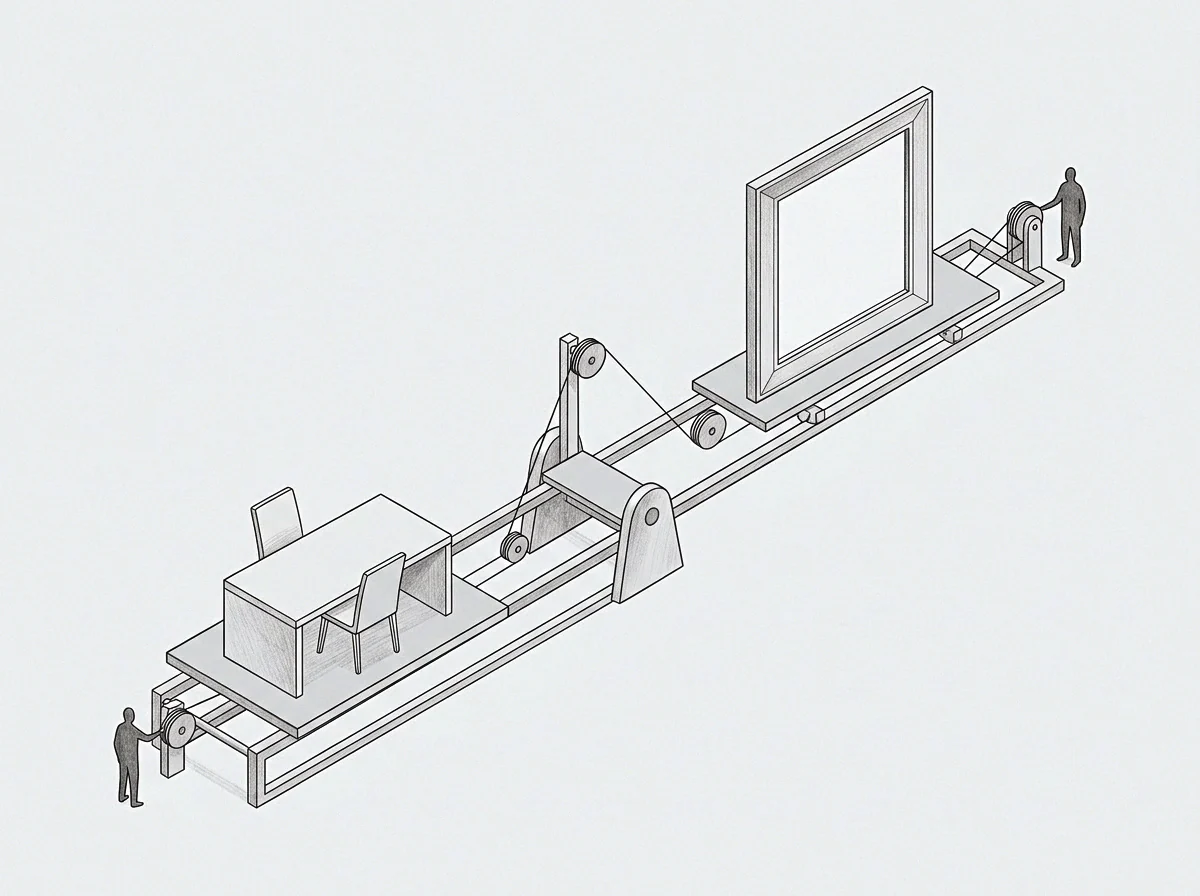
Generalized Reciprocity and Equity Allocation
Early founder equity splits frequently take shape before the operational realities of an enterprise are known. Two or three builders meet in an open room, commit unmeasured hours, and divide ownership into equal chunks. This early division belongs to the domain of generalized reciprocity, where contributions are given unprompted without an immediate demand for matching return.
Early venture formation relies on this unquantified trust. Participants assume that willingness to show up under uncertainty carries uniform value, making the split a shared social pact rather than a valuation of individual economic capacity.
Equal allocations function cleanly while the enterprise operates without revenue or external capital. At this initial stage, work consists of open exploratory tasks where roles overlap continuously. The absence of market pay acts as a common equalizer.
Labor arrives as an unpriced effort for the collective goal, creating mutual obligation without a formal record. Friction emerges when work shifts from exploratory tasks to specialized functional execution, and market forces intrude upon the original agreement.
Equal equity splits created during early discovery treat unmeasured initial commitment as equivalent market contribution.
Formal capital allocations demand precise accounting that generalized reciprocity cannot supply. Investors, key hires, and commercial partners evaluate enterprise roles through market price signals rather than early foundational bonds. A gap opens between the equity percentage granted under early trust and the ongoing replacement cost of each founder.
Managing this gap requires distinguishing the historical value of early arrival from the ongoing value of operational execution.
Uncertainty remains regarding how long an unquantified social bond can sustain alignment before explicit market realignments become unavoidable.

Weight

The Accumulation of Unstated Debt
When enterprise demands scale, individual contribution rates diverge. One founder dedicates eighty hours weekly to product execution, while another operates at thirty hours due to personal liquidity constraints or shifting interest. In a market context, compensation adjusts immediately to reflect differential input, but social pressure often delays explicit pricing within founder teams.
The partner working greater hours continues giving unprompted labor, expecting that equity allocation will naturally reflect the work later. Relying on this unstated understanding introduces systemic fragility.
The cost of unstated asymmetry accumulates silently over long periods. The higher-contributing founder experiences capacity exhaustion, while the lower-contributing founder senses growing unexpressed resentment. Silence preserves initial social harmony at the expense of enterprise stability.
The unprompted gift of extra labor, once offered freely, transforms into an unspoken demand billed during operational stress. Realignment becomes mandatory when this implicit demand exceeds the goodwill remaining between partners.

Structural Asymmetry in Early Inputs
Initial sacrifices vary significantly across different functional domains and individual financial situations. These variations create distinct operational pressures:
- Capital Injection Asymmetry occurs when one founder supplies non-dilutive funds while others supply uncompensated labor, confusing loan terms with equity purchase.
- Time Allocation Variance develops as personal financial reserves dictate how long each builder can survive without market salary drawing.
- Specialized Skill Premium appears when market compensation for a technical role far exceeds the market replacement cost of an administrative role.
- Opportunity Cost Differential arises when one partner leaves a high-paying corporate role while another enters directly from university or unemployment.
Attempting to fix early contributions permanently without dynamic vesting terms guarantees future structural conflict. Capitalization tables reflect historical moments, but operating entities require present alignment. When early equity splits fail to adjust for actual contribution pathways, the enterprise carries a dead weight that limits future hiring and financing.
An unstated expectation of future equity adjustments functions as an unmanaged operational risk.
The operational entity preserves alignment only when contribution imbalances are stated flatly before emotional capital is exhausted.

Chair

Realigning Seat Value and Cash Compensation
Transitioning from sweat equity to market compensation requires separating equity ownership from operational role pricing. Equity rewards early risk and initial asset creation. Salary compensates the ongoing market replacement cost of the seat.
Conflating these two channels prevents rational capital allocation. A founder holding thirty percent of the equity may occupy a functional seat that commands a modest market compensation, while a non-founder executive earns a high salary in a critical growth seat.
Market compensation realignment begins by pricing every executive seat using benchmark data, irrespective of capitalization table equity holdings. The enterprise calculates the market clearing price for each role as if hiring an external candidate. Equity distributions are then treated strictly as return on early risk capital, while cash salaries reflect current functional delivery.
This distinction ensures that high-equity, low-contribution founders do not siphon operational cash needed to recruit key talent.
Is equal equity compensation sustainable after commercial product launch?
Equal cash distributions across different functional roles undermine organizational fairness. Technical and revenue-generating seats face direct external poaching pressures. Paying identical salaries to founders with radically different replacement costs drains cash reserves and demoralizes high-performing partners.
The entity must adopt explicit compensation formulas based on market realities rather than founder egalitarianism.
| Model Dimension | Equal Split Model | Dynamic Milestone Model | Market Realignment Model |
|---|---|---|---|
| Allocation Basis | Identical equity shares assigned at founding moment regardless of future role changes. | Equity grants earned sequentially as specific performance targets are met. | Fixed historical equity coupled with market-rate salaries derived from role benchmarks. |
| Adjustment Mechanism | None, requiring unanimous voluntary renegotiation during operational conflict. | Pre-negotiated clawback terms or earned vesting triggers based on key metrics. | Annual salary reviews paired with discretionary option grants for ongoing outperformance. |
| Relational Impact | High initial trust shifting to unstated resentment as contributions diverge over time. | Transational focus that may diminish early willingness to perform unprompted work. | Clear separation between historical ownership rights and ongoing operational delivery. |
| Investor Perception | Viewed as risky when substantial dead equity remains held by reduced-input founders. | Appreciated for governance governance governance rigor but difficult to draft effectively upfront. | Standard practice preferred by institutional capital during professional funding rounds. |
Failing to realign executive cash compensation with market standards results in key functional seats remaining understaffed or occupied by unmotivated equity holders.

Barter

Converting Early Favors into Formal Terms
The conversion of unquantified sweat equity into formal commercial terms demands clear language. Early contributions that arrived unprompted, such as free office space, informal advisory hours, or personal loan guarantees, require explicit valuation during compensation realignment. Continuing to treat these inputs as open-ended obligations generates chronic governance drag.
The enterprise converts unquantified historical favors into bounded equity grants, severance rights, or flat fee payouts.
Vesting schedules provide the primary tool for managing ongoing equity alignment. Standard four-year vesting with a one-year cliff ensures that initial equity grants are earned through continuous service. When a founder exits early or reduces effort, unvested equity returns to the enterprise pool.
This mechanism protects remaining operators from dead equity overhang. Reverse vesting applied retroactively to initial splits converts early static allocations into conditional grants tied to future performance.
Dynamic equity split models offer an alternative to fixed splits during early phases. These models assign points to inputs including unpaid hours, cash injections, intellectual property contributions, and key relationships. The final equity split calculates automatically based on the accumulated points when the enterprise reaches cash-flow positivity or secures external funding.
Dynamic systems maintain generalized reciprocity during early exploration while ensuring strict mathematical fairness when formal valuation arrives.
Converting informal promises into explicit legal contracts protects the enterprise from historical debt claims.
Uncompensated early work builds core enterprise value that later investors monetize at lower relative cost.

Scale

A Worked Realignment Scenario
Take two founders, Founder A and Founder B, who established an enterprise three years ago with an explicit fifty-fifty equity split and zero cash compensation. Founder A supplied the original technical architecture and continued working eighty hours weekly as Chief Technology Officer. Founder B provided early market introductions, served as Chief Executive Officer, but reduced operational commitment to twenty hours weekly after year two to manage separate business interests.
The enterprise now raises three million dollars in institutional seed capital, requiring clear executive compensation schedules and an updated capitalization table.
Assume the investor term sheet demands that all key operators draw market-aligned salaries and commit full-time effort under four-year vesting schedules. Founder A demands an equity adjustment, arguing that Founder B’s reduced effort over the past twelve months created an unearned equity advantage. Founder B maintains that early market introductions secured the initial strategic accounts that made the seed funding possible.
The institutional investor refuses to close the transaction while fifty percent of the equity remains attached to a part-time operator.
The enterprise implements a three-part compensation and equity realignment:
- Unvested Equity Clawback applies a mandatory milestone recapitalization, returning twenty percent of Founder B’s unvested equity to the unallocated option pool for key hires.
- Differential Executive Cash Salary sets Founder A’s market salary at one hundred eighty thousand dollars full-time, while Founder B receives forty-five thousand dollars scaled to part-time operational delivery.
- Board Seat Governance Restructuring reallocates board voting rights to reflect active full-time operational leadership rather than historical equity percentage.
Under this arrangement, Founder A retains thirty-five percent vested equity plus market cash pay. Founder B retains fifteen percent equity with reduced vesting, accepting reduced cash pay while relinquishing operational control. The transition preserves Founder B’s early risk contribution without burdening the ongoing operating budget.
The enterprise secures the funding round while establishing explicit pricing for future executive inputs.
A clawback clause tied to ongoing full-time service converts unearned historical equity into available option capacity for incoming operators.

Seal

Establishing Stated Terms for Sustainable Governance
Resolving founder equity friction requires moving permanently from unstated social contracts to explicit legal agreements. Generalized reciprocity serves enterprise creation during initial uncertainty, but market-clearing terms protect enterprise survival during growth. Realignment conversations are uncomfortable because they force founders to state explicit market prices for past and present contributions.
Avoiding these conversations trades temporary personal comfort for enterprise mortality.
Sustainable governance rests on regular formal reviews of executive compensation and equity vesting terms. Founder agreements must include buyout terms, dispute resolution mechanics, and clear definitions of full-time operational commitment. Setting clear dates for annual compensation reviews removes the emotional weight from realignment discussions.
Equity decisions then become routine administrative steps rather than urgent relational crises.
When terms are stated clearly once, the cost of ongoing operation drops dramatically. Operators dedicate their full capacity to commercial execution rather than tracking unstated relational debts. The enterprise establishes a durable structure capable of absorbing capital, attracting executive talent, and navigating market shifts.
Clear contracts keep the initial joint vision intact while granting the business the operational freedom to scale.